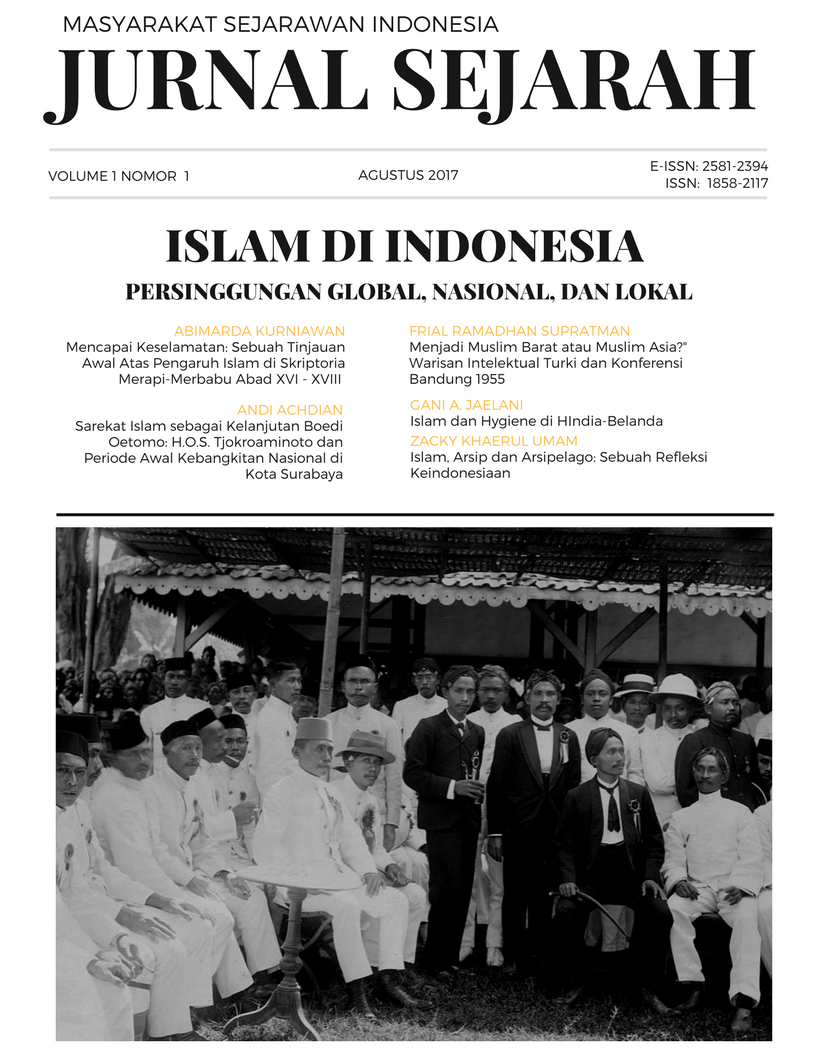
Islam dan Persoalan Higiene di Hindia Belanda
Keywords:
Colonialism, higiene, Islamic doctrine, physician, public health, Netherlands-IndieAbstract
This research seeks to elaborate the question of hygiene in its relation with the
Islamic doctrine in Netherlands-Indie. In the colonial world, hygiene is
inevitably related to the colonial politic in order to assure the well-being of the
population and the good health of the workers. A number of projects since the
mid-19th century, such as the creation of Dokter Djawa School in 1851 and the
programme of vaccination, were the indicator of the attempt to improve the
health status of the population, along with the hygiene program in the
plantation to assure the health status of the workers. Physicians who were
dealing with this question frequently encountered difficulties in socializing the
idea of hygiene. Since the majority of the population was moslem, they were
trying to use the Islamic doctrine which is in line with the principle of hygiene
in their propaganda. This article will try to analyze how the physicians used the
Islamic doctrine in their works; how physicians treat the image of Islam as a
religion from a medical point of view.